Understanding Commercial Solar Dryers and Their Role in Value Added Agriculture
Wiki Article
Introduction
Agricultural products often need careful handling after harvesting. Fruits, vegetables, spices, herbs, grains and other products may contain significant moisture, making drying an important processing step for suitable commodities. For generations, farmers have used open-sun drying, but this method leaves products exposed to changing weather and outdoor contaminants. Modern solar drying technology provides an enclosed alternative that uses solar thermal energy to assist moisture removal.
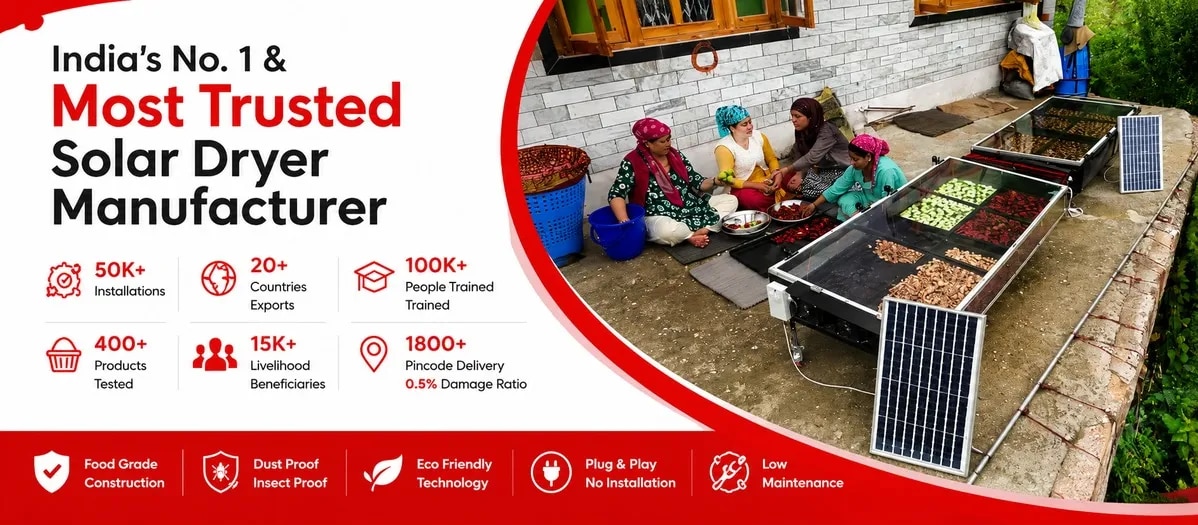
Rudra Solar Energy manufactures solar thermal systems and offers a range of solar dryers for agricultural and food-processing applications. Its current solar dryer range includes cabinet dryers, fruit dryers, vegetable dryers, spice dryers, herb dryers, agricultural product dryers and larger commercial drying systems. The company states that its cabinet dryer configurations range from 5 kg per batch to 500 kg per batch.
What Is a Solar Dryer?
A solar dryer is an enclosed system that uses solar heat to warm air and assist in removing moisture from suitable products. Instead of placing food directly under the open sky, the material is loaded inside a drying chamber, generally on trays or another organised support system.The basic principle is straightforward. Solar radiation provides thermal energy, the drying air becomes warmer, and moisture moves from the product into the surrounding air. Air movement then helps carry moisture away.
Why Enclosed Drying Matters
Open-sun drying can be inexpensive, but the product is exposed to dust, insects, birds and unexpected rain. An enclosed solar dryer creates a defined processing environment and can reduce direct exposure to these outdoor conditions.Rudra Solar Energy describes its cabinet solar dryer as an enclosed tray-based system designed to reduce direct exposure to dust, insects, birds and sudden rain compared with open-sun drying.
Applications of Solar Drying
Solar drying is not limited to one crop. The suitable application depends on the physical characteristics of the product and the required final condition.Rudra Solar Energy lists applications involving fruits, vegetables, spices, herbs, grains, pulses, oilseeds, seeds, flowers, fish and other suitable agricultural materials.
Fruits and Vegetables
Fruits and vegetables can be prepared in different ways before drying. Depending on the product, preparation may involve washing, peeling, slicing, cutting or grading. Slice thickness and loading quantity can influence the drying process.A solar fruit dryer can therefore be useful when a farmer or processor wants to convert suitable fresh fruit into dried material for further processing or packaging.
Spices and Herbs
Spices and herbs can also be suitable for solar dehydration. Rudra Solar Energy lists dedicated solar spice and herb dryer options within its product range. :contentReference[oaicite:3]index=3The actual drying conditions should be established according to the specific commodity rather than assuming that every spice or herb requires the same process.
Factors That Affect Drying
Drying performance depends on more than the temperature inside a chamber. The starting moisture level, product size, loading depth, airflow, humidity, solar radiation and desired final moisture condition can all influence the process.Rudra Solar Energy specifically notes these variables when describing the operation of its cabinet solar dryer.
Important Know More considerations include:
- Product type and variety
- Initial moisture content
- Preparation and slice thickness
- Quantity loaded per tray
- Airflow through the chamber
- Ambient humidity
- Available solar radiation
- Required final moisture condition
This is why a single drying time should not automatically be applied to every product.
Solar Dryers for Farmers and FPOs
Solar drying can be relevant to farmers, farmer producer organisations, cooperatives, self-help groups and agricultural processors. The technology can form part of a value-addition process where suitable fresh produce is converted into a dried product.Rudra Solar Energy states that its agricultural products dryer is intended for farmers, FPOs, SHGs, cooperatives and commercial processors, with capacity configurations from 5 kg per batch to 500 kg per batch.
Capacity Planning
Capacity should be selected according to actual processing requirements. A small farmer processing occasional batches may not need the same configuration as an FPO handling regular seasonal production.A business should consider fresh material availability, number of batches, processing season, available space and potential future expansion.
Hygiene and Food Handling
An enclosed solar dryer can provide a more organised environment than open-sun drying, but the machine alone does not guarantee food quality.Raw material selection, cleaning, Solar Dryer Supplier preparation, tray hygiene, operator practices, packaging and storage all contribute to the final product.
After Drying
Once the drying stage is complete, the product may need cooling before packaging. It should then be stored in conditions appropriate for the particular dried material.If dried material absorbs moisture again during storage, the intended benefit of dehydration may be reduced.
Solar and Backup Options
Solar availability changes during the day and across seasons. Depending on the selected model and application, additional heating can provide operating flexibility.Rudra Solar Energy lists optional electric or biomass backup for suitable configurations.
Whether backup is necessary depends on local weather, processing schedules, product requirements and the level of operational continuity needed.
Conclusion
Solar dryers provide a practical method of using solar thermal energy for suitable agricultural and food-processing applications. Solar Dehydrator Compared with open-sun drying, an enclosed solar drying system can provide a more organised environment and reduce direct exposure to outdoor contaminants and sudden weather changes.Rudra Solar Energy offers solar dryer configurations for different products and processing scales, including systems from small batches through larger commercial applications.
Businesses should select a dryer according to the actual product, fresh quantity, moisture requirements, preparation method, airflow needs, available space and processing schedule. When combined with proper preparation, hygiene, packaging and storage, solar drying can become a useful part of agricultural value addition.
 Report this wiki page